The Constitution Is Not Colorblind. It Never Was.
Breaking new ground, the Supreme Court of the United States exults a founding document that doesn’t exist.
Sherrilyn Ifill Jun 09, 2026
Image: Douglas Rissing/iStock
It may be that the most consequential sentence of the Supreme Court’s latest decision in Allen v. Milligan, the ruling that dealt a blow to Black political representation in Alabama, comes in the majority’s opening sentence. There, in an unsigned opinion issued on the Court’s maligned shadow docket, the six-member majority exults “our colorblind Constitution.”
Although individual conservative justices on this Court have often made reference to the concept of colorblindness in concurring or dissenting opinions in various civil rights cases, placing it as the opening pronouncement in Milligan reads as a calculated provocation.
Of course, colorblindness is the basis upon which the Court, led by Chief Justice John Roberts, struck down race-conscious admissions practices at universities and colleges in 2023, in Students for Fair Admissions v. Harvard. And the refrain has become standard fare in opinions in which the conservatives on the Court join or dissent from decisions upholding or striking down affirmative action remedies.
But by front-loading this statement at the opening of a decision that uses the concept to make remedial efforts to cure racial gerrymandering unconstitutional, the conservatives seemed to hope that the brushback pitch of “our colorblind Constitution” would put those of us ready to call out the Court’s dastardly project on our back feet.
After all, who could be against a colorblind Constitution? To disagree with the Court on this is to invite that most odious of charges: Only someone who is themselves a racist — reverse racist, if you will — would reject the principle of colorblindness as a constitutional imperative.
But I come against it. I reject it for the simple reason that our Constitution is not colorblind. It never was.
The majority borrows this phrase, of course, from Justice John Marshall Harlan’s dissent in Plessy v. Ferguson in 1896. In that case, Justice Harlan admirably refused to join the majority in its decision that state-mandated racial segregation does not violate the Equal Protection Clause of the 14th Amendment. The majority’s monstrous decision sanctioned Jim Crow legalized apartheid, under which most Black people would then live for well over 60 years, until the Court’s decision in Brown v. Board of Education in 1954, and the legislative victories of the Civil Rights Movement of the 1960s.
Since then, individual justices on the Supreme Court have cynically deployed “colorblindness” to oppose efforts to ameliorate or reverse racial exclusion and inequality.
But our Constitution is not colorblind; for one, the word colorblind appears nowhere in the text of our Constitution. And the claim to a colorblind Constitution is belied by countless provisions in our founding charter, by the legislative history of the most consequential amendments that deal with equality, and by the principal case that overturned legal apartheid in this country.
Begin with the opening words of our first Constitution — “We the People” — which excluded vast swaths of “people” from our founding document’s protections and promises. Or consider the method set forth in Article I, Section 2 for calculating the population for congressional representation. Or ponder the provision in Article I, Section 9 to allow the continuation of our nation’s participation in the international slave trade. In all of these provisions, race has always been present in our Constitution.
The inherent conflict in forming a country based on principles of liberty and freedom, while remaining fully steeped in the buying, selling, and labor exploitation of millions of Black people, was not lost on this country’s constitutional drafters. It is precisely why the words slavery and Black people do not appear in the original document.
But no one doubts to whom the Three-Fifths Clause applied despite the delicacy of the language employed by the drafters to describe who is to be counted as a fraction of a human being (“all other persons”) in calculating congressional representation. The slave trade is delicately referred to in Article I as the “importation of persons,” but it was well understood that this provision by its own terms was meant to constitutionally sanction the continuation of U.S. participation in the grotesque immorality of the international slave trade until 1808.
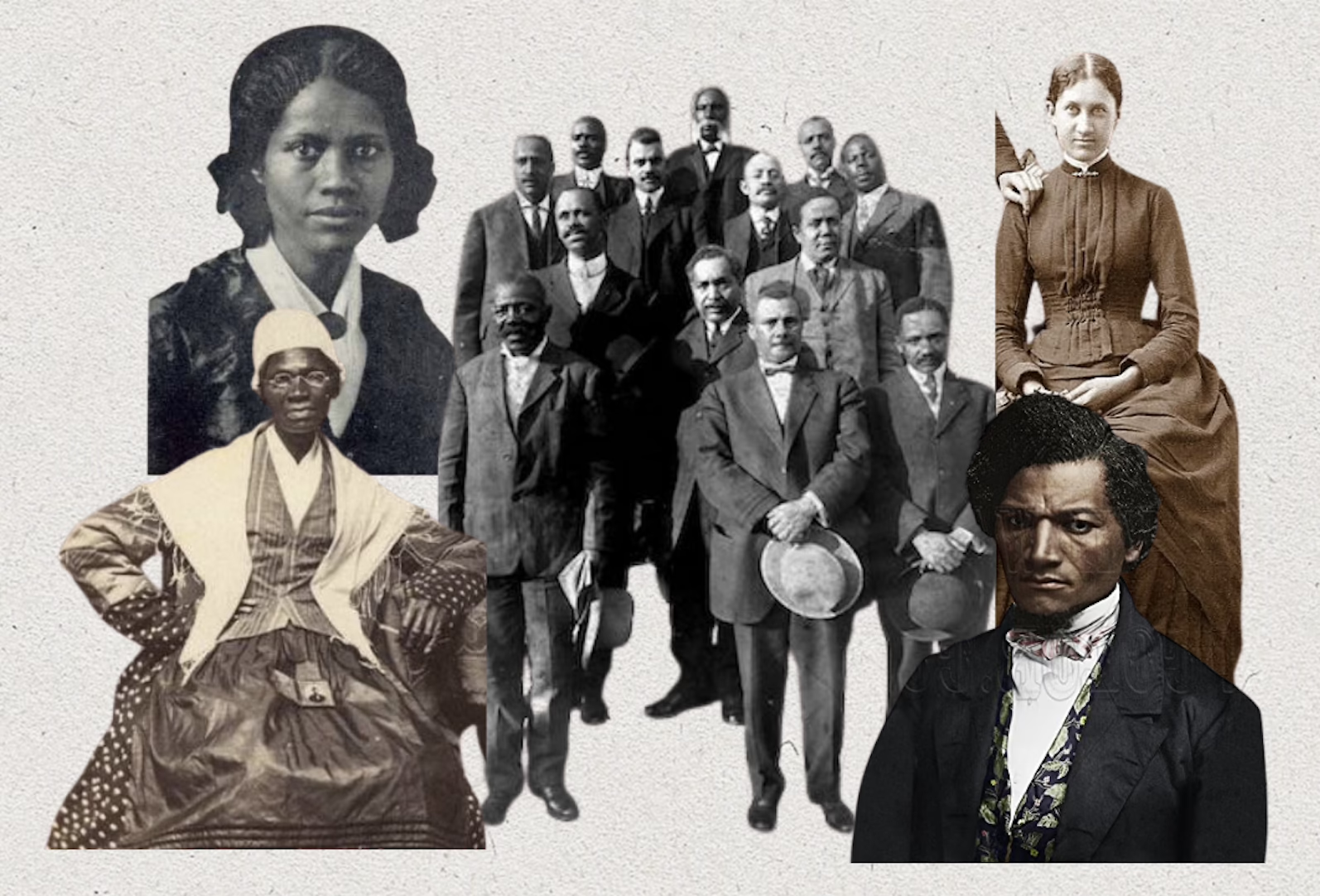
The framers of our Second Founding who debated and drafted the 13th, 14th, and 15th Amendments during Reconstruction were not so fastidious. Their work followed a disastrous and devastating Civil War fought over the determination of southern states to continue the system of chattel slavery on which their economy depended, and from which many of their white citizens derived a sense of status and pleasure.
The Reconstruction amendments they drafted were explicitly race-conscious. The purposes of those amendments are clear and unequivocal in the legislative history and in the protections they afford: to ensure the full citizenship of Black people; and to protect the political participation of Black people. The three amendments did precisely that, resulting in the ability of Black people to own land, to obtain public education, and to elect 16 Black men to Congress and many others to state level offices in the 25 years after the war’s end.
“Colorblindness” likewise appears nowhere in the Supreme Court’s decision in Brown v. Board of Education, the seminal case our current Court purports to uphold when it insists on colorblindness. And the core civil rights statutes that emanated from the Civil Rights Movement — the Civil Rights Act of 1964, the Voting Rights Act of 1965, and the Fair Housing Act of 1968 — were enacted by Congress for the explicit purpose of protecting Black people against ongoing and systemic racial discrimination and inequality. And they were a product of Congress’ explicit enforcement power under the 14th and 15th Amendments.
It is also time to have a more fulsome discussion about Justice Harlan’s dissent in Plessy. I have championed Justice Harlan’s admirable opinions during Reconstruction — often in dissent — reinforcing principles of equality for Black Americans, including in the Civil Rights Cases, in which he dissented from the Court’s decision to strike down the Civil Rights Act of 1875. But it seems odd to ignore Justice Harlan’s commentary in Plessy about the Chinese, just a few paragraphs after his statement that our Constitution is colorblind.
Part of Justice Harlan’s critique of the majority’s decision in Plessy is that it would allow discrimination against Black railroad passengers, but not Chinese passengers. It is hard to square Harlan’s colorblindness talk with his statement that
“There is a race so different from our own that we do not permit those belonging to it to become citizens of the United States. Persons belonging to it are, with few exceptions, absolutely excluded from our country. I allude to the Chinese race. But, by the statute in question, a Chinaman can ride in the same passenger coach with white citizens of the United States.”
And let us not forget Justice Harlan’s dissent in the 1898 birthright citizenship case United States v. Wong Kim Ark, in which he agrees with the proposition that “the President and Senate by treaty, and the Congress by naturalization, have the power, notwithstanding the Fourteenth Amendment, to prescribe that all persons of a particular race, or their children, cannot become citizens.” It is worth questioning whether Justice Harlan’s conception of a colorblind Constitution has much applicability to our modern understanding of racial equality. Asian American scholars have long written with tremendous depth and clarity about the anti-Chinese sentiments expressed by Justice Harlan in these opinions. The conservative majority’s refusal to address the complicated legacy of Justice Harlan’s embrace of “colorblindness” can only be deliberate at this point.
I refuse to continue the pretense that colorblindness is a vision for our country grounded in our Constitution. It has become a weapon designed to cloak the Court’s decisions dismantling our civil rights infrastructure with a veneer of principled nobility. It represents at best, the wishful thinking of justices who have declared their sensibilities to be too delicate to concern themselves with, as Chief Justice Roberts once put it, “this sordid business” of “divvying us up by race.” At worst, it is a cynical ploy designed to erase the work of activists, lawyers, and Congress who built a civil rights infrastructure to advance Black equality. Or perhaps a long game effort to tie the hands of future Congresses that might be inclined, as Congress was during the Civil Rights Movement, to respond to demands for equality and justice by passing civil rights laws.
The Framers of the Reconstruction amendments sought explicitly to confront the destructive power of white supremacy which had broken our nation in half. They had witnessed the catastrophic consequences of the Supreme Court’s decision in the Dred Scott v. Sanford case, which set us on the pathway to the Civil War. They were struggling against a President Andrew Johnson, who had already vetoed their efforts to statutorily ensure Black citizenship and equality. So they gave Congress alone the power to oversee what they knew would be the long-term work of fulfilling the guarantee of equal protection.
This Court has taken that power from Congress and imposed its own ill-informed and stubborn conception of the parameters permitted by our Constitution for addressing the lasting and destabilizing effects of structural white supremacy. In so doing, that Court may well have destroyed our only chance of becoming a true multiracial democracy.
Share