14th Amendment Center Statement on Supreme Court Ruling in Trump v. Barbara
Founder Sherrilyn Ifill welcomes the reaffirmation of birthright citizenship, which has been our foundational law since 1868.
14th Amendment Center Staff Jun 30, 2026
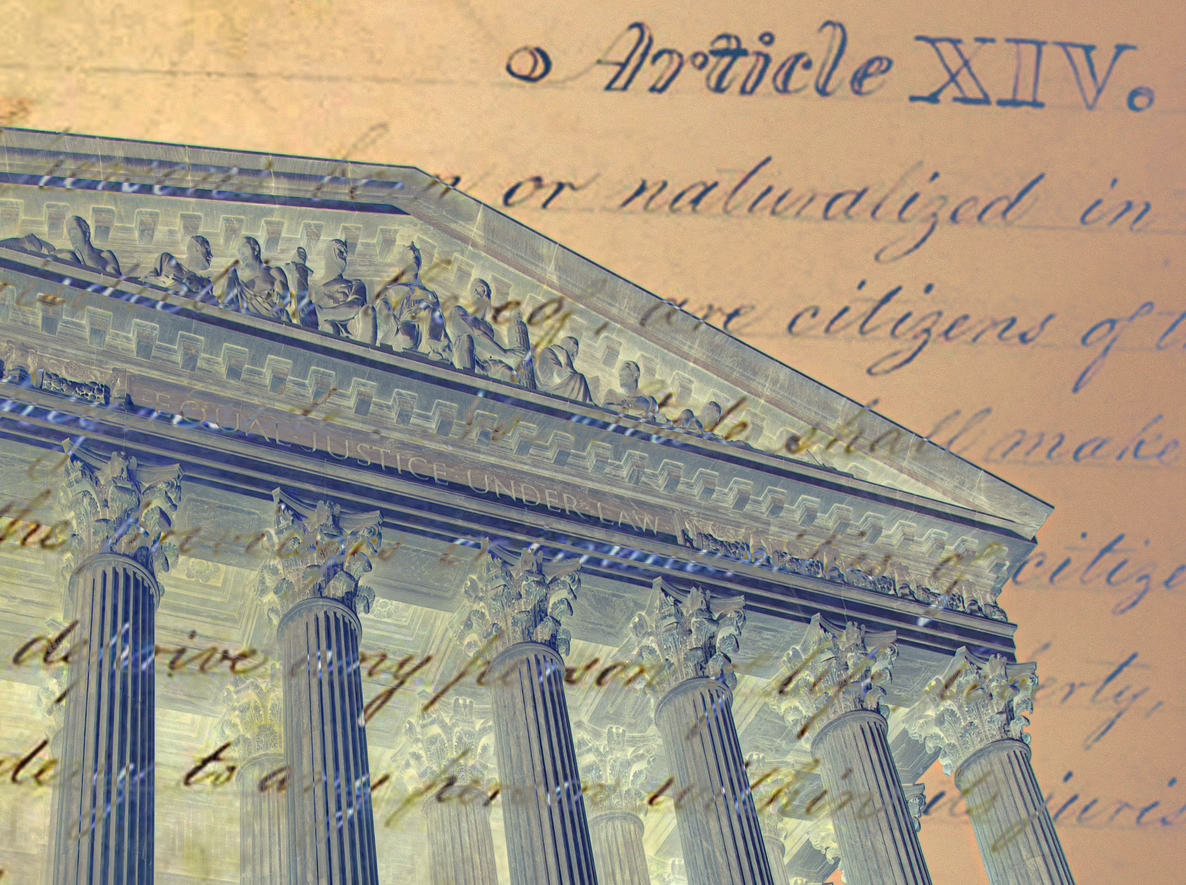
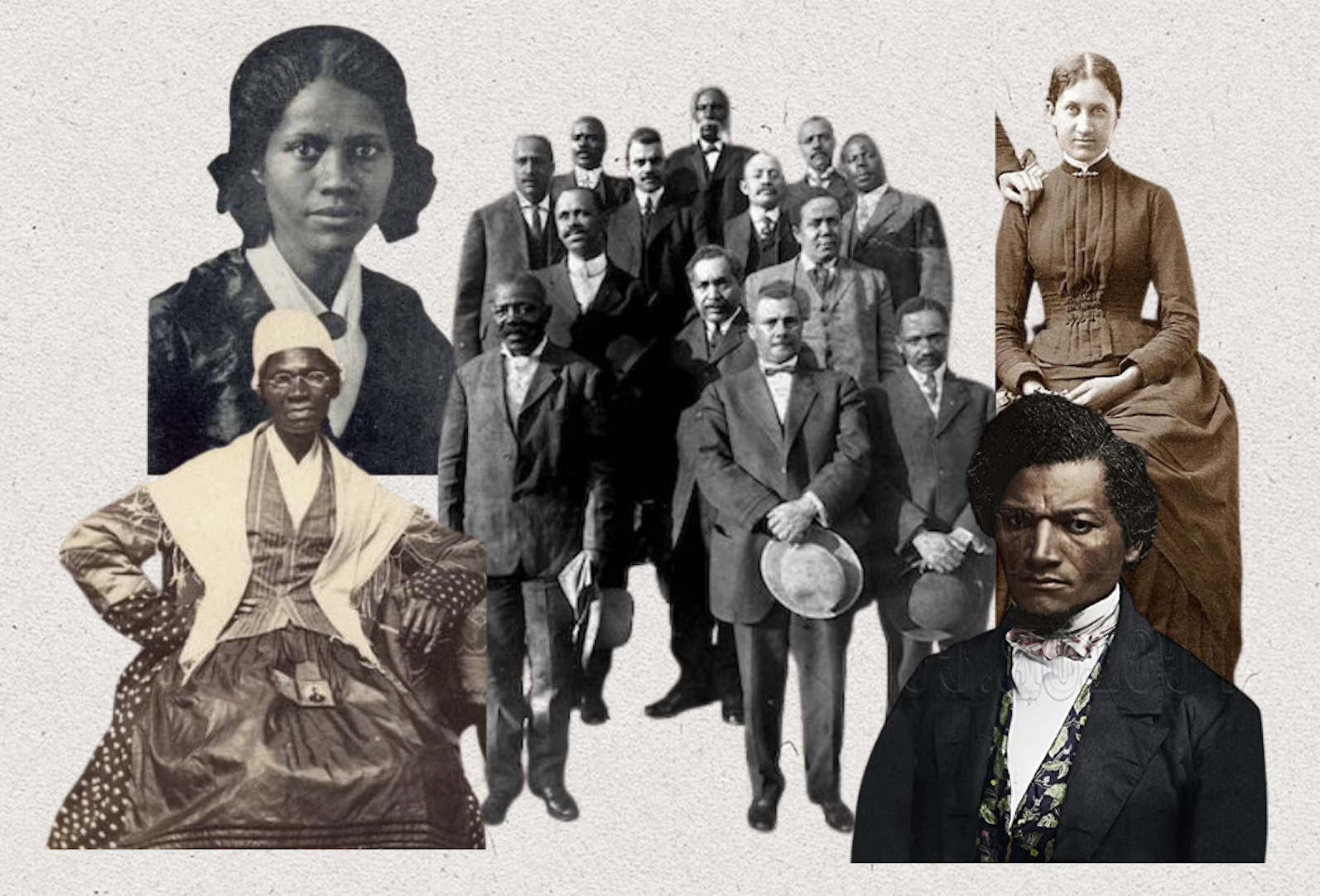
Library of Congress/iStock/14th Amendment Center
Today, the Supreme Court affirmed what the 14th Amendment has always said: If you are born on American soil, you are an American citizen. That is not a policy preference. It is not a matter of political debate. It is the law of this country, ratified in 1868 in the wake of the Civil War, written in plain language, and defended by generations of Americans who understood what was at stake when a government claims the power to decide who belongs.
In Trump v. Barbara, in an opinion by Chief Justice John Roberts, the Supreme Court held that children born in the United States to parents unlawfully or temporarily present are “subject to the jurisdiction” of the United States and are citizens at birth under the Fourteenth Amendment’s Citizenship Clause. “Citizenship, then and now, was the right to have rights — to freely participate in our political community,” Roberts wrote. “The Framers of the Fourteenth Amendment extended that promise to ‘every free-born person in this land.'”
I am relieved by this ruling. But I am deeply troubled that this decision was not unanimous. Three justices dissented from the majority opinion. And one justice, Brett Kavanaugh, wrote to express his belief that Congress can do what the president couldn’t by executive order.
We must continue the fight to affirm the power and promise of the 14th Amendment until all Americans understand, as Justice Ketanji Brown Jackson reminds us in her concurrence today: “The Reconstruction Amendments were an anticaste, antisubordination reset for the Nation, not a mere spot treatment for the dark stain of slavery.”
We must not forget that the Supreme Court could have put an end to this question more than a year ago when the challenge to birthright citizenship came to the Court as Trump v. CASA. Instead, the justices allowed the debate about who is truly American to be fueled by blatantly anti-constitutional rhetoric. Frankly, the Court’s willingness to even hear this case is a low mark in its decision-making.
The effort to strip birthright citizenship from certain children born in the United States has long been a conservative political project dressed in constitutional language — one that required ignoring the text of the amendment, the history of its drafting, and more than 125 years of settled law. The Court should have rejected Trump’s executive order when the earlier iteration of this case was first presented for certiorari.
The only bright side to the long ordeal of this case is that many more Americans today better understand the power and promise of the 14th Amendment, and the meaning of birthright citizenship. I want to salute the scholars, historians, advocates, and legal professionals who filed briefs, published scholarship, and stood publicly in defense of the 14th Amendment. Their work mattered.
At the 14th Amendment Center, we co-authored an amicus brief in this case alongside Professor Guy-Uriel Charles of Harvard Law School, with research support from Howard University School of Law students in my 14th Amendment seminar. We argued that the plain meaning and historical purpose of the Citizenship Clause admits no exception for children born to certain classes of parents.
Today’s ruling vindicates that argument. More importantly, it vindicates the children and families whose citizenship — whose very belonging in this country — was placed in question by this administration.
But today’s ruling does not mean the 14th Amendment is safe. Every component of this amendment is under pressure right now — birthright citizenship, equal protection, due process, and the enforcement powers of Congress. The administration that brought this case has made it clear that it does not accept the constitutional framework of equal citizenship established by the 14th Amendment. One Supreme Court decision, however correct, does not change that posture.
The work of the 14th Amendment Center continues. We will keep building the scholarship, the legal arguments, the public understanding, and the next generation of civil rights lawyers who know how to defend this amendment — not just today, but in every case, in every court, in every legislative chamber where its guarantees are challenged.
This is not a moment to exhale and move on. If today’s ruling moved you — if the knowledge that American citizenship was genuinely at risk concerned you — I ask that you support the work of the 14th Amendment Center. Help us build the institution this constitutional moment demands.
The 14th Amendment belongs to all of us. So does the responsibility to defend it.
* * *
ABOUT 14TH AMENDMENT CENTER FOR LAW AND DEMOCRACY
The 14th Amendment Center for Law and Democracy at Howard Law School is a hub for legal scholarship, advocacy, and strategic collaboration and convening focused on advancing democracy and equal rights, led by Sherrilyn Ifill, the Vernon Jordan Jr. Distinguished Professor of Civil Rights and former president and director-counsel of the NAACP Legal Defense Fund.