A Message on the 158th Anniversary of the Ratification of the 14th Amendment
Under assault from all sides, the 14th Amendment holds the key to keeping us and the U.S. together, that we may see the dawn of this country’s Third Founding.
Sherrilyn Ifill Jul 10, 2026
Image: 14th Amendment Center
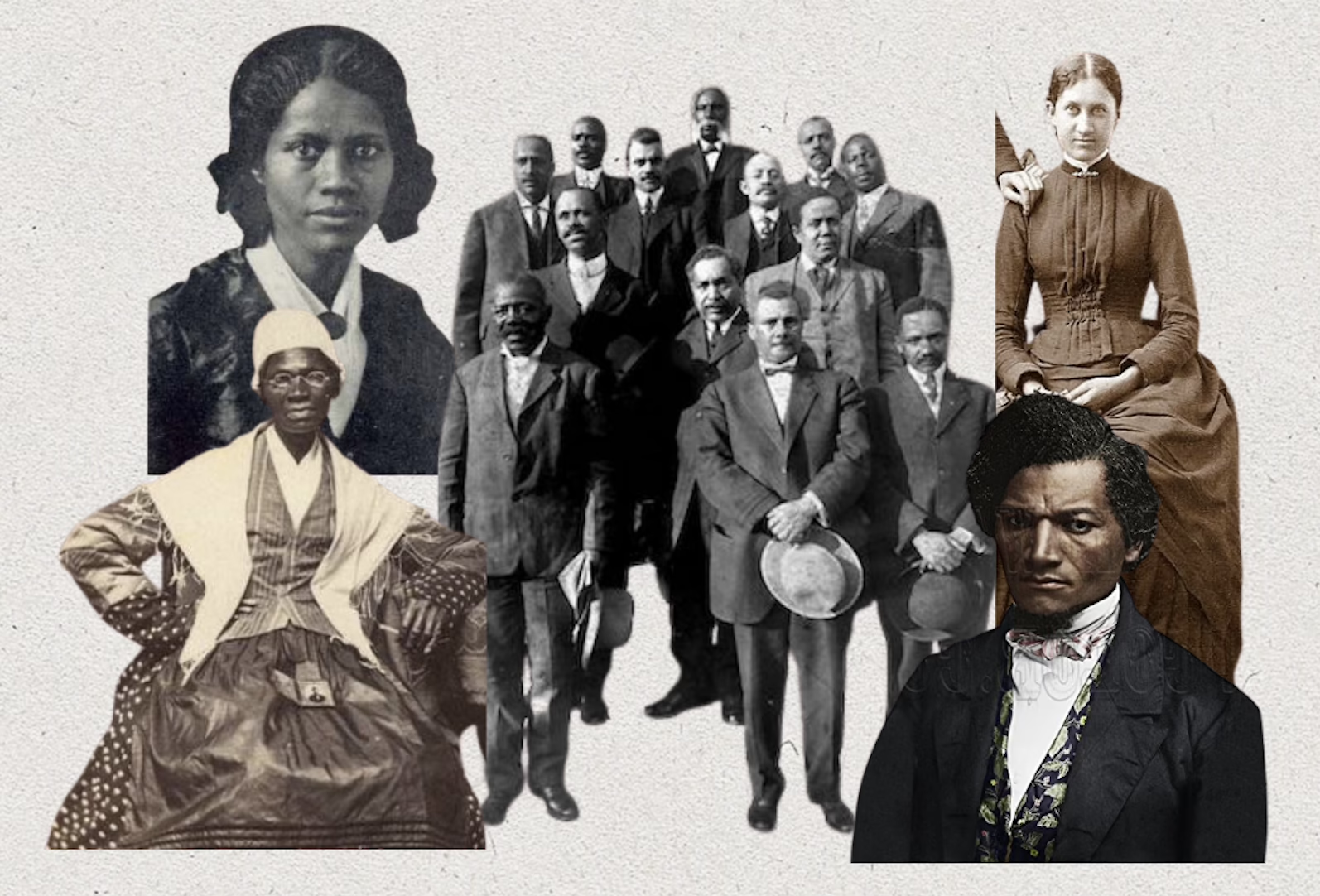
One hundred and fifty-eight years ago this week, the 14th Amendment was finally ratified and became, as historian Eric Foner has observed, “the most consequential addition to our Constitution since the Bill of Rights.” The 14th Amendment fully ushered in America’s Second Founding, providing the blueprint for a new nation. The longest amendment to the original Constitution, its provisions enshrined birthright citizenship, the concept of equality, and a sweeping array of protections aimed at containing the twin evils of white supremacist ideology and insurrectionist spirit that live in our national DNA. Our second Founders left no stone unturned.
Since its ratification, the 14th Amendment may also be the most contested part of our Constitution. By “most contested,” I do not mean merely the volume of litigation filed to claim or challenge the protections of one of the guarantees promised in the amendment. The 14th Amendment is the one addition to our Constitution that is fervently and consistently tested by those who fundamentally oppose what it stands for. It is not solely that they contest the scope of the amendment’s reach, but that they have convinced so many Americans, through narrative devices and other stratagems, to disbelieve the very premise of the Amendment — that this country can become a true multiracial democracy in which equality and justice are essential elements of our national identity.
Over the past 30 years, these challenges have gained more purchase than we have seen since the period in the late 19th Century when Reconstruction’s end was hastened by mob violence, congressional lassitude, and a hostile Supreme Court, that smothered the potential power and reach of the 14th Amendment
When Black civil rights lawyers and activists demanded reclamation of the amendment’s promise in the middle of the 20th Century — forcing the Supreme Court, Congress, and ultimately the American public to fully reckon with the guarantee of equality — it was the 14th Amendment’s guarantees that anchored the effort. The Civil Rights Movement and the litigation that successfully unfolded alongside it remain among the most powerful and transformative democracy movements in the modern world.
Of course, the backlash against the Civil Rights Movement’s success began almost immediately. Over the course of 40 years, a new Supreme Court, a more divided Congress, and a nation that remained fundamentally ambivalent about the consequences of true equality once again undermined the 14th Amendment’s potential. Still, the hard-fought and won legal infrastructure and the norms that developed around the commitment to equality offered strong resistance to the forces of backlash.
Today, there is a full-on assault on the 14th Amendment advanced by a majority of the members in each branch of our government. The latest examples are the Court’s decisions in Louisiana v. Callais and Allen v. Milligan, in which the Court distorts the meaning and application of the Equal Protection Clause, declares (incorrectly) that our Constitution is “colorblind,” erects new barriers to obtaining relief for racial discrimination, and overturns a congressional amendment to the Voting Rights Act and the Supreme Court precedent that upheld it. All of this constitutes a usurpation of Congress’s explicit power to enforce the protections set forth in the Reconstruction amendments. In this concerted onslaught, the norms and legal scaffolding that protected the core promise of the 14th Amendment have been badly shaken.
Yet it will be the people once again — lawyers, yes, but also teachers, artists, faith leaders, students, working- and middle-class parents and families, elders who remember our history, and all of those who care about democracy — who will reclaim what Justice Ketanji Brown Jackson recently described as the “universalist” purpose of the 14th Amendment. Our effort, as today’s refounders, will not simply be to repeat the successes of the past, or to focus solely on law. Instead, using the 14th Amendment as a guide, our goal must be to create a new, stronger, and more enduring infrastructure on which to build a better, sturdier, and more sustainable vision for multiracial democracy in our country.
This new “refounding” begins with learning the truth about how our country was remade after the Civil War and the significance of that history to the challenges we confront today. I encourage you to use our website as a learning tool. Attend our programming. Participate in our events. Equip yourself with knowledge of how this country was remade, and of the forces that have turned us away from our greatest moments. From this, you will learn that this process is an iterative one. Democracy demands ongoing work and vigilance. The path to a better future begins with understanding our past.
If we remain focused and fully prepared to do the work of citizenship, and bring to that work the courage, conviction, and vision of the founders and framers of the 14th Amendment’s promise, we may well see together the dawn of this country’s Third Founding.