The 14th Amendment and the U.S. Census Are Once Again Under Threat
The Trump administration is proposing changes that would dramatically alter who gets counted in the United States.
14th Amendment Center Staff Sep 11, 2026
iStock
The 14th Amendment to the Constitution abolished the Three-Fifths Compromise, a feature of the original Constitution that apportioned political power in Congress among the several states by counting enslaved African Americans as three-fifths of a person. As written, Section 2 of the amendment made no distinctions as to who gets counted: “Representatives shall be apportioned among the several States according to their respective numbers, counting the whole number of persons in each State.”
The Trump administration, in yet another usurpation of the plain language of the 14th Amendment, has proposed a new regulation that would exclude broad swaths of people who would otherwise be counted in the decennial Census, based on their legal status under the immigration laws. Under the proposal, which is now subject to public comments, undocumented immigrants “should not be included in the apportionment count, as they are not true inhabitants, members of the body politic, or persons with a ‘usual residence’ in the United States due to their lack of a sufficient tie and allegiance to the United States.” These rationales bear a striking resemblance to the administration’s justifications, now rejected by the Supreme Court, to limit birthright citizenship.
The proposed rule would likewise add a citizenship question to the census questionnaire, thus returning to the political fray another scheme that the Supreme Court invalidated in 2019. In that case, the court set aside the addition of the citizenship question under the Administrative Procedure Act, but nonetheless ruled that the Constitution “permits Congress” and the Department of Commerce, which oversees the U.S. Census Bureau, “to inquire about citizenship on the census questionnaire.”
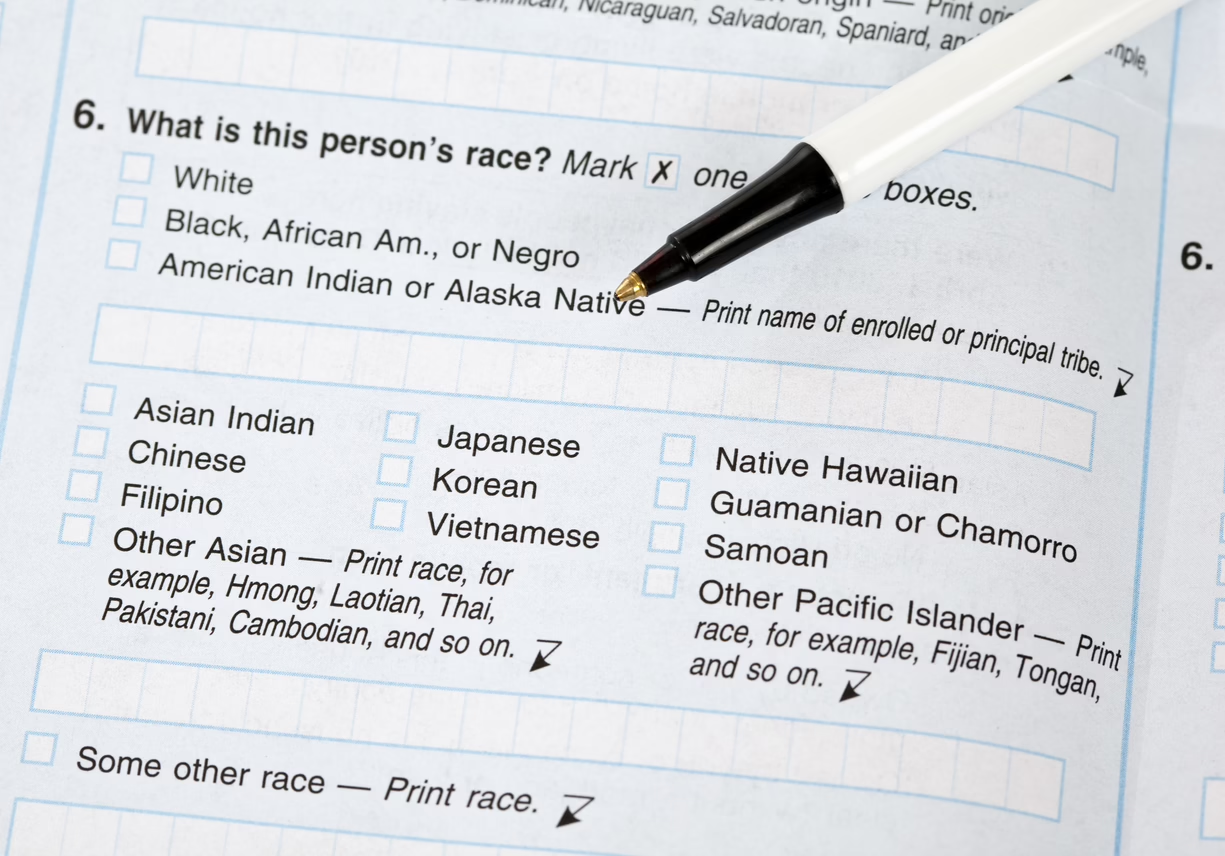
In addition, the proposal relies heavily on the Supreme Court’s decision ending affirmative action in higher education and its recent moves against Black political representation in the South — in Louisiana v. Callais and Allen v. Milligan — to push for the elimination of race, ethnicity, and sexual orientation questions from the census questionnaire. A version of these questions has been asked since the first census taken in 1790. The Census Bureau contends that these longstanding demographic questions, which are central to civil rights enforcement and the administration of public programs, “would reduce response burden as well as the risk of disclosure” and somehow “ensure fairer political representation.”
All told, if the proposed rule goes into effect, states with sizable immigrant populations, such as California and Texas, stand to lose significant political representation in Congress. And in mixed-status homes where U.S. citizens and undocumented family members reside, the mere specter of inquiring about citizenship could risk depressing participation in the decennial count. Separately, the elimination of race, ethnicity, and sexual orientation questions would whitewash a critical dataset that has long guided policymakers, researchers, and the public alike.
And to the extent the new proposal leaves Black, Latino, Asian American, and other minority communities underrepresented in Congress or left out of critical public programs and funding, or is otherwise driven by discriminatory animus — as may have been the case with an earlier attempt to undermine the census — the rule may well violate the Equal Protection Clause of the 14th Amendment, as applicable to the federal government under existing precedent.
In light of these constitutional defects, the 14th Amendment Center for Law and Democracy condemns this proposed rule and is evaluating next steps, including participation in the public-comment period. Please consider subscribing to our newsletter for updates on this crucial new front against the 14th Amendment — and to learn more about how all of us play a role in protecting it and the future it secures for all people.