Ketanji Brown Jackson Uplifts the ‘Universalist’ Purpose of the 14th Amendment
Her powerful concurrence in Trump v. Barbara is a model for how we should think, write, and talk about the centerpiece of the post-Civil War amendments.
14th Amendment Center Staff Jul 04, 2026
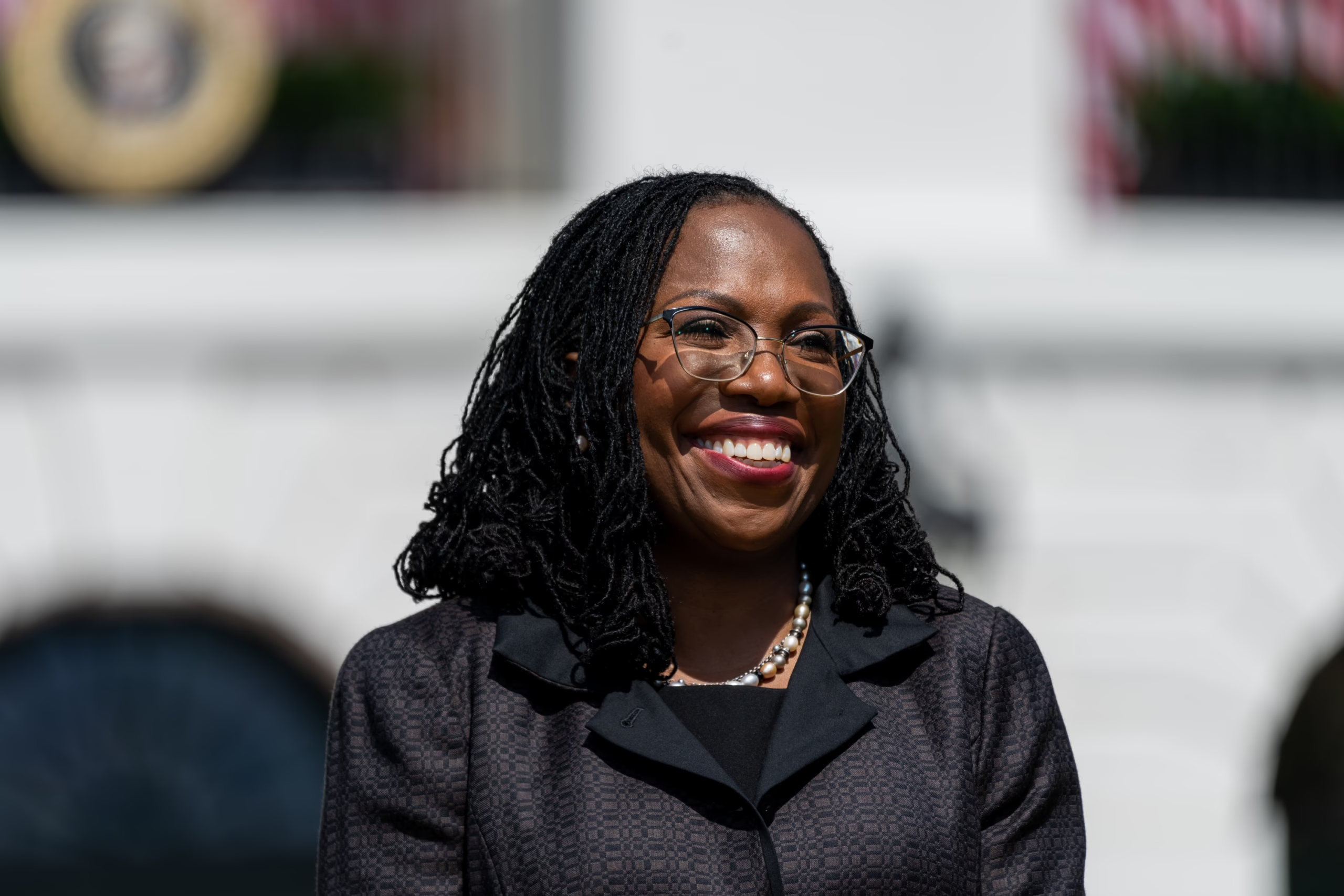
The White House/Wikimedia Commons
Justice Ketanji Brown’s concurring opinion in Trump v. Barbara, which reaffirmed the principle of birthright citizenship found in Section 1 of the 14th Amendment, is far more than a judicial opinion. Her words, offered as a corrective to Justice Clarence Thomas and the federal government’s “ahistorical” view of the amendment, tells the real story of how the centerpiece of our Constitution came to be — and what its enduring promise means for us today.
The 14th Amendment Center for Law and Democracy would be remiss to not highlight that an amicus brief coauthored by its founder, Sherrilyn Ifill, with key support from her seminar students, was cited in Justice Jackson’s concurrence — as well as the works and scholarship of many friends of the center. Among them are legal scholars and historians Eric Foner, Martha Jones, Kate Masur, and Gerard Magliocca.
This 4th of July weekend, as the nation stops to observe the 250 anniversary of our original founding, the 14th Amendment Center is reprinting Justice Jackson’s concurrence in full — in the hopes that her call to remember our second founding, the United States “that was reborn from the rubble of the Civil War,” is also part of our celebrations.
(For length and ease of reading, footnotes and some in-line citations have been omitted. The full slip opinion can be found at this link.)
* * *
JUSTICE JACKSON, with whom JUSTICE SOTOMAYOR joins as to the introduction and Part I, concurring.
I join the Court’s opinion in full. I write separately to respond to some of the themes in the principal dissent. Despite his longstanding endorsement of a “colorblind” Constitution, JUSTICE THOMAS now surprisingly suggests that the Citizenship Clause was a race-conscious remedial measure, relating only to “freed slaves such as Dred Scott,” and those who shared with them certain characteristics, post, at 1 (“no other homeland”); post, at 21 (“called America home”). It is for this reason, he says, that “children who were born in the United States but [to parents] not domiciled here” are not entitled to claim birthright citizenship. But that narrow vision of the Fourteenth Amendment bears little relationship to the history of its ratification. Even worse, JUSTICE THOMAS’s telling elides the entire point of the Second Founding: The Reconstruction Amendments were an anticaste, antisubordination reset for the Nation, not a mere spot treatment for the dark stain of slavery.
I
It is common ground that the Fourteenth Amendment was “enacted . . . with the one pervading purpose of securing equal citizenship for the freed slaves.” Also true is the fact that this Court “has time and again denied Americans that promise.” But consensus about the Fourteenth Amendment’s central motivation does not justify JUSTICE THOMAS’s myopic treatment of it. The Amendment caused a paradigm shift in the trajectory of our Nation; the teacher who scolds a student for bullying a classmate hopes the student learns the broader lesson of treating everyone with kindness, not just that one kid.
In the aftermath of the Civil War, those who championed the Fourteenth Amendment—both within and beyond Congress—understood the assignment. Their work product used “language that transcended race and region,” and thereby “changed and broadened the meaning of freedom for all Americans.” Instead of the limited salve the principal dissent makes it out to be, the Citizenship Clause reflects this universalist approach.
A.
Consider, first, the voices of those outside the chambers of the Senate and the House of Representatives, whose advocacy and organizing culminated in the Fourteenth Amendment. First in the North (as States abolished slavery), and then in the South (after Emancipation and the Union’s victory in the Civil War), Black people who were generally not permitted at the polls or in the halls of power mobilized nevertheless to advance the universalist vision of belonging and citizenship that eventually won the day.
The odds were long and the stakes were high. Indeed, around the time they gained their freedom, former slaves faced a crisis similar in relevant respects to the American immigrant experience. With little in terms of possessions and even less in terms of opportunities to make a living for themselves and their families, freed Blacks were not ushered warmly into the broader community (with apologies or compensation), set up for success, or even given the rights and privileges others enjoyed. Though they’d tilled the soil for centuries and had labored to build every building, once freed, they were basically treated as “ strangers ” in a not-so-strange land.
This was not for lack of trying to survive and belong on the freedmen’s part. They constructed churches, schools, and mutual-aid societies—safe zones amidst America’s racialized social and economic order. Outside those enclaves, however, freed Blacks were characterized as unassimilable and incapable of full civic participation. Their humanity was disregarded. Serious doubts about their claims to citizenship were also being sown. The reason was clear: “[A]n integrated, race-blind society under the rubric of ‘all men are created equal’—required a societal commitment to” antisubordination principles and practices, i.e., “a well-resourced effort to undo the damage done to black people by slavery.” But “even the most ardent opponents of slavery recoiled” from that prospect.
One solution that gained traction in the early 1800s was to physically separate the freedmen and other Black people from the general polity. Antislavery Northerners and proslavery Southerners found common cause in the idea that freed Blacks would surely “be happiest in a black-led republic, beyond the contempt of and competition with white Americans.” This vision of “paternal caste” prompted the creation of the American Colonization Society, which established the colony of Liberia and pushed for freed Blacks to relocate there voluntarily. Once freed Blacks were out of sight, they would (thankfully) be out of mind, eliminating any need for a racial reckoning in America.
Meanwhile, many States pushed the envelope, passing “Black Laws” (in the pre-War North) and “Black Codes” (in the post-War South), intending to make it difficult for freed Blacks to live and work there. Violence, too, played a significant role in the isolation effort. Those who opposed abolition banded together with those who resented the extra competition in the job market to form marauding mobs, ransacking Black neighborhoods, homes, and stores. And local law enforcement? They did little to help. Before Emancipation, per the federal Fugitive Slave Act, state officers pursued and arrested Blacks suspected of having escaped slavery. Afterwards, the cavalry looked the other way when Black neighborhoods were terrorized by vigilante violence. The Ku Klux Klan would form, and then flourish, starting in 1866.
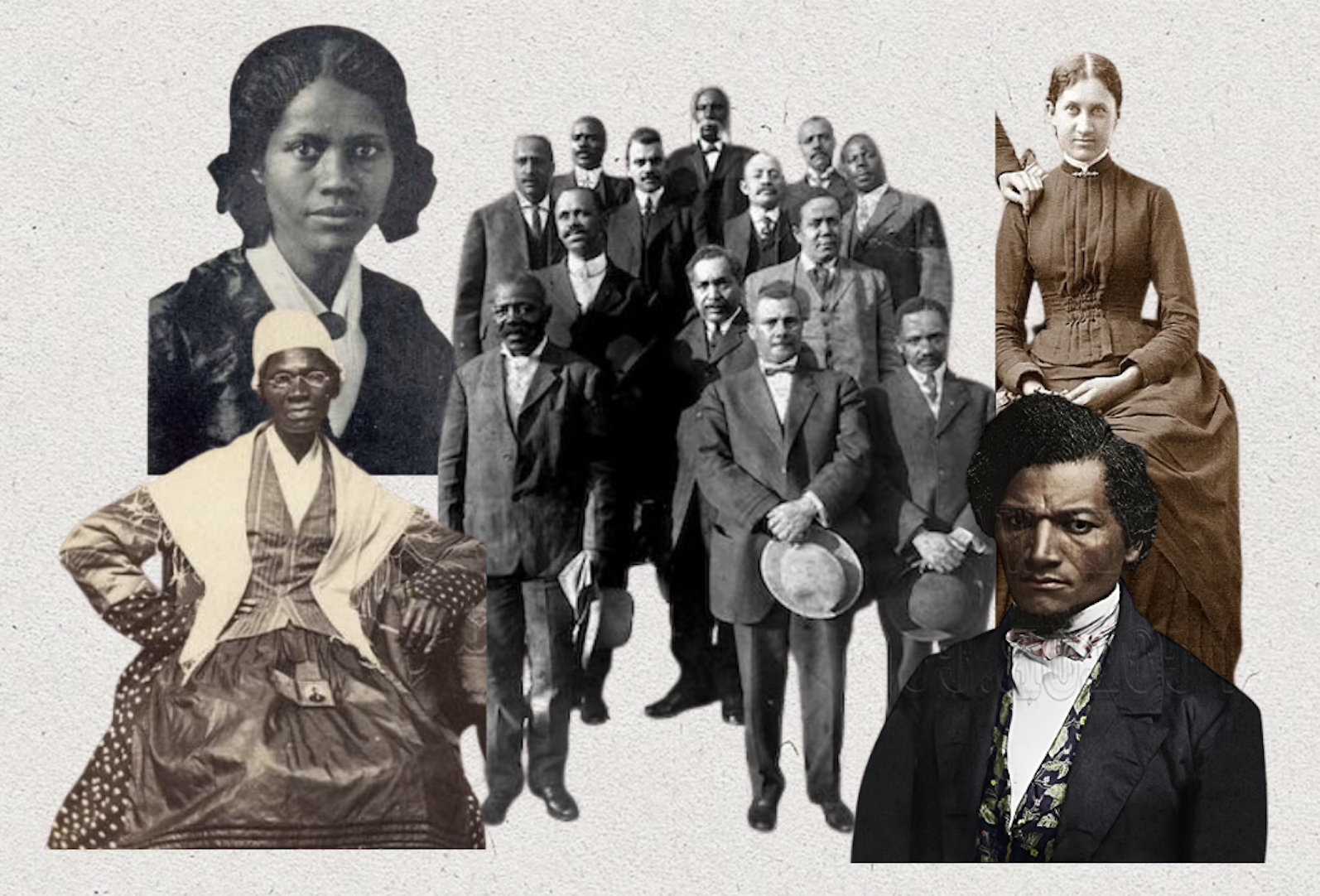
Still, most freed Blacks resisted the pressure to selfdeport. Instead, many started organizing toward the creation of the kind of Nation the colonizationists opposed— one that guaranteed liberty and justice for all. In the decades leading up to the ratification of the Fourteenth Amendment, Black Americans organized and gathered at more than 600 local and national conventions across the country. There, delegates erected the political and intellectual scaffolding for the Fourteenth Amendment and, later, for the Black Civil Rights Movement more generally.
Critically for present purposes, these visionaries already understood themselves to be American citizens. “The refrains ‘we are Americans’ and ‘we are citizens’ echoed in conferences throughout the North.” Moreover, “[b]irthright figured importantly” as “delegates frequently characterized their status as that of native-born citizens.” The delegates argued that, as such, they had the requisite allegiance, so, at a minimum, the Federal Government owed them the duty of protection.
The famed orator Frederick Douglass was one of these delegates. Capturing the spirit of the moment, Douglass proclaimed that Chief Justice Taney—the author of the majority opinion in Dred Scott v. Sandford—“[could] do many things, but he [could not] . . . change the essential nature of things.” In the absence of the artificial evils of slavery and racial subordination, Douglass explained, “the glorious birthright of our common humanity, will become the inheritance of all the inhabitants of this highly favored country.”
Do note this: The citizenship thesis of the Colored Conventions was thus not that some new status should be created and conferred on freed Blacks. It was instead that freed Blacks already had a rightful claim to citizenship because they had been born on American soil. After all, the Nation, from its founding, had “boldly proclaim[ed] that all men are born free and equal, and that consequently life, liberty, and the pursuit of happiness, are inherent in every individual, vested inalienably by natural birthright.”25 No ideal was more inherently American. Now, “rest[ing their] cause on the republican standard of the revolutionary Fathers,” freed Blacks were “knock[ing] at the doors of the constitution and demand[ing] an entrance.” And “[i]f . . . asked what evidence [they] bring to sustain [their] qualifications for citizenship, [they would] offer them certificates of . . . BIRTH and NATIVITY.” Would the Nation live up to its promise?
Such universalist appeals were a conscious choice. Yes, Black Americans had suffered a singular wrong. And yes, they had “‘fought and bled’” for the Union, paying a steep price for their freedom. But the delegates did not rest on these laurels. Rather, they drew upon the moral and political force of the universal principles that were already core to the Nation’s identity.
That bears repeating: Freed Blacks did not advocate for a unique set of rules that catered only to their situation. Nor did they seek to advance their own position relative to, or at the expense and exclusion of, other marginalized groups. Instead, those whose gatherings helped galvanize the push for full equality understood that “[a] diverse origin does not disprove a common nature, nor does it disprove a united destiny.” The firmest foundation for freedom would require an anticaste reset—“both for his sake and for ours”—and would benefit all.
During his U.S. Senate candidacy, Abraham Lincoln developed a similar vision. In the lead-up to the now-famous Lincoln-Douglas debates, Lincoln explained that the promise of liberty and equality in the Declaration of Independence “was held sacred by all, and thought to include all.” Lincoln expressly and intentionally linked the fate of Black Americans and immigrant groups (“among us perhaps half our people who are not descendants at all” of the Founders), and noted that the Nation’s future hinged on a universal definition of citizenship that excluded neither. He explained that the Declaration’s promise that “all men are created equal” was the “electric cord . . . that links the hearts of patriotic and liberty-loving men together,” regardless of race or descent.
The case was made. First, there was war. And then, the delegates’ (and Lincoln’s) universalist view of citizenship made its mark on the Constitution.
B.
The Civil Rights Act of 1866—the predecessor to the Citizenship Clause—was initially drafted as a spot treatment. Senator Lyman Trumbull’s first proposal homed in on the freedmen and provided merely that “all persons of African descent born in the United States are hereby declared to be citizens of the United States.” If that language had prevailed, the view JUSTICE THOMAS asserts today might be well founded. See post, at 4–5 (finding birthright citizenship’s “feudal” origins inconsistent with Congress’s focus on “secur[ing] equal rights for the freed blacks”).
But Senator Trumbull changed his mind. The day after he submitted that first proposal, he requested to “withdraw [the original] and . . . offer another in lieu of it to the same purport, changing the phraseology.”
Consistent with the views espoused by activists, Trumbull’s new proposal adopted a distinctly universalist register: “All persons born in the United States, and not subject to any foreign power, are hereby declared to be citizens of the United States, without any distinction of color.” This is the language Congress would eventually enact as part of the Civil Rights Act of 1866. And the Civil Rights Act of 1866 would go on to become the basis for the Fourteenth Amendment’s Citizenship Clause.
Senator Trumbull’s progression from specific to universal was more than mere word choice. In the face of the virulent anti-immigrant—and, in particular, the anti-Chinese and the anti-Romani—sentiment of that era, language targeting just freed former slaves would have been the path of least (or less) resistance. But Senator Trumbull, along with those colleagues who took up the same mantle during the ratification debates, expressly rejected that narrow framing.
Do not miss this context. Throughout the mid-19th century, Chinese immigrants to America were often portrayed as “‘coolies,’” a racist slur implying indentured servitude and allegiance to a Chinese master. Some Members of Congress brought that sentiment to the Civil Rights Act’s citizenship-related debates. Notably focusing his attention beyond freed former slaves, Senator Edgar Cowan, for example, argued that German immigrants’ children born in Pennsylvania should be citizens, but Chinese immigrants’ children should not—because Germans and Chinese were different. In response, Senator Trumbull emphasized that the law he had drafted drew no such distinctions.
Undeterred, Senator Cowan would warn again—this time during debates on the Fourteenth Amendment—that the Citizenship Clause would let Chinese immigrants “overrun” California and “double or treble the population” of that State. Senator John Conness of California, where anti-Chinese sentiment was arguably most pronounced, responded that “the children begotten of Chinese parents in California . . . shall be citizens.” In fact, he said, the Civil Rights Act had already declared “that the children of all parentage whatever . . . should be regarded and treated as citizens of the United States.” No Senator rose to agree with Senator Cowan or dispute what Senator Conness had said. And no Senator said what the principal dissent says today: that the text at issue conferred citizenship only on freed Blacks and those in analogous situations.
The debates went similarly with respect to the Roma people, who were referred to at the time as “gypsies.” When asked whether native-born Romani children would be birthright citizens of the United States under the proposed Civil Rights Act, Senator Trumbull replied: “Undoubtedly.” President Andrew Johnson apparently agreed. In his message vetoing the Act, Johnson noted with disapproval that, under the law, “the Chinese of the Pacific States, Indians subject to taxation, the people called gypsies, as well as the entire race designated as blacks,” would be birthright citizens. Without making any changes to the bill or responding that Johnson was mistaken in his understanding of it (or otherwise capitulating to Johnson’s views in any respect), Congress overrode that presidential veto.
During the ratification debates, Senator Cowan took aim at the Roma people too, characterizing them as undeserving of birthright citizenship because they “wander[ed] in gangs,” “infest[ed] society,” and “impos[ed] upon the simple and weak everywhere.” And again, Senator Conness dismissed Senator Cowan’s prejudices: “The only invasion of Pennsylvania within my recollection was an invasion very much worse and more disastrous to the State, and more to be feared and more feared, than that of Gypsies. It was an invasion of rebels [at Gettysburg].”
When ratified, the Citizenship Clause thus vindicated the universalist vision of the delegates at the Colored Conventions and their allies in Congress. Far from the principal dissent’s representations, freed Blacks did not receive citizenship as a reward for their military service or for having, through no choice of their own, “no other homeland [and] no allegiance to any foreign power.” Instead, the Amendment recognized their rightful claim to birthright citizenship simply and solely by virtue of their having been born on American soil. John Bingham—one of the Amendment’s principal architects—said this clearly: The “rights of citizenship” are universal because they are the “sacred rights of person[hood].”
With this recognition, the U. S. Constitution finally got an anticaste engine. And with it, the Nation gained a new font of legitimacy and vitality.
II
Fast forward 150 years, to 2026. Section One of the Fourteenth Amendment still contains that same universalist language, consistent with its origins and the ratifiers’ intent. So, respondents say, our Constitution confers citizenship upon almost anyone and everyone who is born on American soil—to include the children of immigrants and temporary sojourners not domiciled in the United States— just as it did at the time of the Fourteenth Amendment’s ratification.
But the Government’s view (which the principal dissent adopts) rejects this. Its argument focuses on the fact that the Citizenship Clause had a particular purpose: to reverse Dred Scott’s holding that Black Americans were not entitled to citizenship. See Brief for Petitioners 13–14; post, at 1–2. The reasoning is, in essence, that the Fourteenth Amendment recognized freed Blacks as citizens because they had “‘fought and bled’” in the Civil War, “had no other homeland, owed no allegiance to any foreign power, and were subject to no other authority.” Thus, the argument goes, the Amendment’s guarantees are for only Black Americans and those who fit their fought-and-bled-for-country, no-otherhomeland, domiciled mold.
That contention is ahistorical for the reasons laid out in Part I, and those explained in the Court’s opinion. In my view, it is also difficult to square with the notion of a “color-blind” Constitution, which has loomed large in the Court’s Fourteenth Amendment jurisprudence. The Court’s conception of a color-blind Constitution and the Government’s (and principal dissent’s) cramped, group-specific reading of the Citizenship Clause are two sides of the same coin, stemming from a basic misunderstanding of the relevant history. As I have shown in this opinion, the Fourteenth Amendment is not color-blind; rather, its core principle is that our Nation does not tolerate racial caste—i.e., the systemic subordination that many (even some who opposed slavery) had wished to perpetuate after the Civil War. So, the architects of the Second Founding did not think or pretend that race didn’t matter. Quite to the contrary, they understood that race made an enormous difference to the lived experiences of all concerned—and to the fate of our union. Indeed, it is for that very reason that a radical restructuring was required. The Citizenship Clause applies universally precisely because such universal application was necessary to achieve the Amendment’s own race-conscious remedial purposes.
Putting a finer point on this: When colonizationists objected to changing their norms to accommodate the equal citizenship and rights of freedmen, freed Blacks and their allies organized to push for a Constitution that would bring their own antisubordination vision to fruition. That kind of ambitious transformation—nothing less than the remaking of the soul of a Nation beset by rank, entrenched race-based prejudice and inequity—did not come for free, or purely by the say-so of those who claimed to be “color-blind.” It required heavy lifting, a fundamental shift—the very thing for which the Fourteenth Amendment stands: a repudiation of the notion that there is a “superior, dominant, ruling class of citizens,” Plessy, 163 U. S., at 559 (Harlan, J., dissenting), and a willingness to see, and strive to eliminate, all remaining vestiges of historical subjugation.
So the principal dissent is wrong to complain that the Court “has repurposed the Fourteenth Amendment to protect . . . rights that the Reconstruction Congress never contemplated.” Delegates to the Colored Conventions drew upon their own experiences to successfully argue for a new Constitution—one that protected fundamental human rights, including an individual’s “‘right to own his body and mind’” and “the right of personal security and protection against injuries to our bodies or good name.” Thus, even in cases where the protagonist was not a Black American, this Court’s Fourteenth Amendment cases have focused, at bottom, on the same universal liberty and equality interests that motivated the Fourteenth Amendment itself. The question is (and always has been): Does the affected individual or group enjoy equal dignity? And the correct answer is (and has always been) to heed the Fourteenth Amendment’s universalist, antisubordination command. Our Nation did not undergo something as profound and world-shifting as “Reconstruction” for naught.
* * *
After the Civil War, Fredrick Douglass frequently reflected on the events of the time through the lens of biblical stories. In one speech, Douglass described how God leveled Sodom and Gomorrah on account of sin, and how, in the aftermath, Abraham stood atop a nearby mountain to survey what remained. “[T]he orator used the image of Abraham looking down upon the destroyed landscape to demand that Americans look down upon their own recent self-destruction, and all but unjustified survival, and remember.” Douglass declared that his own aim was to “‘show that nations should have memories.’”
In the time since Douglass’s prescient observation, Americans have come to learn that fading memories are not the only danger. The distortion of historical facts—retellings that reimagine and repurpose past events to lend credence to misbegotten aims—may be an even greater threat.
Yet here we are. The Government, the principal dissent, and a handful of revisionist commentators now vigorously promote an interpretation of the Citizenship Clause that diverges sharply not only from what the text says, but also from the historical record as interpreted by the keepers of “the call of remembrance” (trained historians). What is more, this alternative account pitches Black Americans against immigrants when the advocates who promoted the Fourteenth Amendment did no such thing. Freed Blacks fought for the shared humanity of all people. And the Great Emancipator eventually foresaw that the only path forward that could prevent a return—in any form—to slavery and race-based subordination was to link the fates of all.
Ultimately, then, it is the Government and JUSTICE THOMAS who have “repurposed the Fourteenth Amendment.” Post, at 91. By ignoring that our Constitution stands firmly against caste and subjugation—on all axes and in all manners—they deny the clear, universalist vision shared and proclaimed by the Fourteenth Amendment’s Framers: to “rebuild a shattered empire . . . to plant deep and solid the corner-stone of eternal justice, and to erect thereon a superstructure of perfect equality of every human being before the law.”
Of course, the ultimate irony is that for all the talk about the detestable Dred Scott decision, the Government and the principal dissent propose a return to its core tenet. Their bottom line is that, for certain people, being born on American soil will not suffice to confer citizenship. It is that odious conclusion that the Citizenship Clause plainly rejects, as the Court explains. I add only that the Fourteenth Amendment’s universalist aims should forever be the death knell for this kind of claim—one that seeks to make bloodline the marker of birthright. The America that was reborn from the rubble of the Civil War simply does not countenance that inequitable result. Thankfully, a majority of the Court remembered this today, and has dutifully preserved the most basic animating principle of our Nation’s founding—that all human beings are created equal—once more.