The Year in Review, and the Year Ahead
The fight for the 14th Amendment continues—now more than ever.
Sherrilyn Ifill Jan 01, 2026
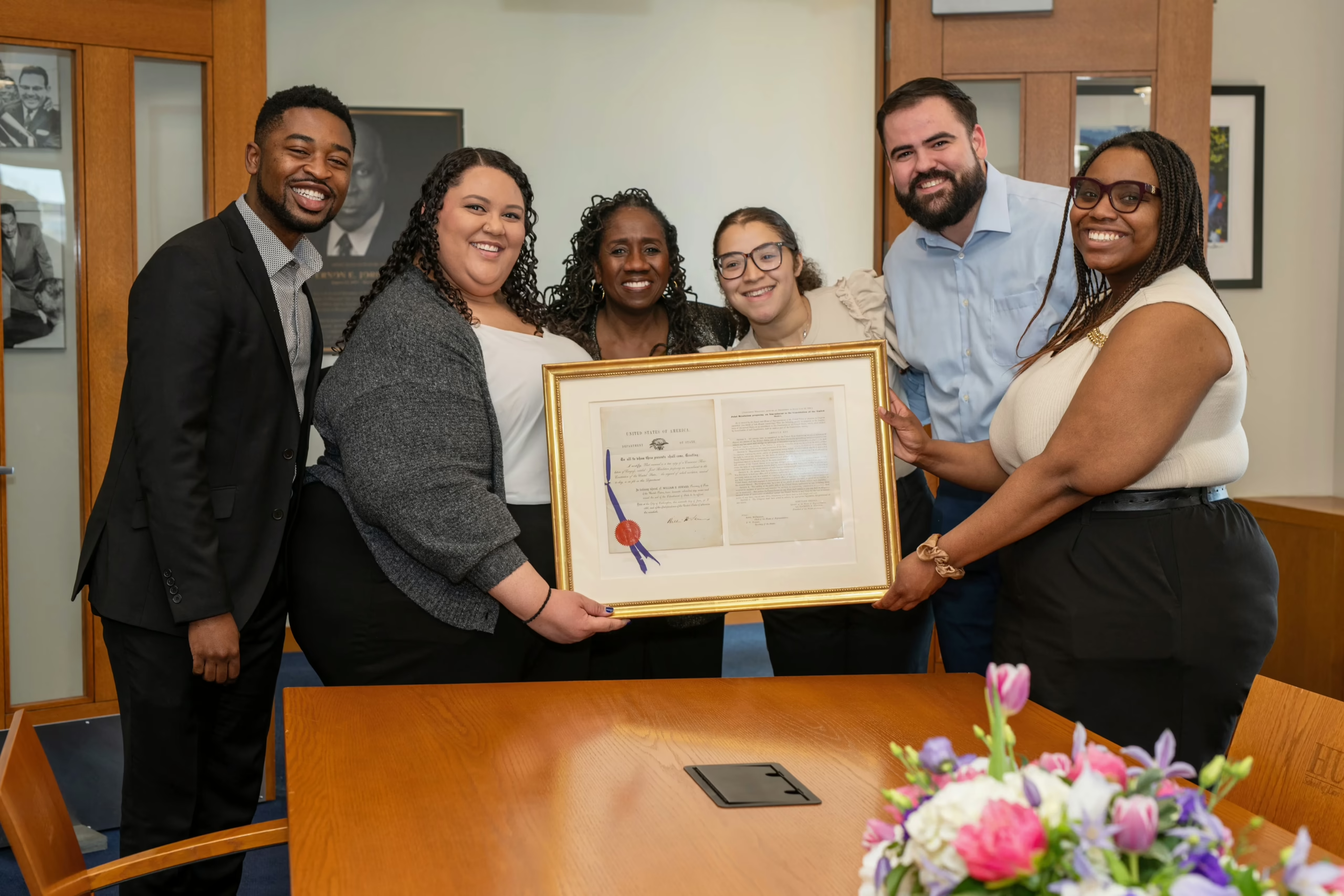
14th Amendment seminar students at Howard Law School stand with an original of the 14th Amendment on loan for the 14th Amendment Center’s opening symposium (March 27, 2025).
This post first appeared in The Refounding, the 14th Amendment Center’s newsletter for ideas and commentary.
* * *
When I first conceived the idea of creating a 14th Amendment Center, I dreamed of doing work that would, at long last, make the 14th Amendment as familiar to Americans—and as revered—as the First Amendment. I also hoped to ground a new generation of law students in a deep understanding of the (as yet unrealized) promise of the 14th Amendment.
Nearly a year after the Center’s launch in 2024, I see clear signs that we are well on our way. The 14th Amendment has taken center stage in many of the most volatile and important political and legal debates of our time—though, I admit, often not for the reasons I had hoped.
The ongoing challenge to President Trump’s effort to end birthright citizenship, as it has been understood for more than 160 years, will come to a head this year when the Supreme Court takes up the issue this spring in Trump v. Barbara.
At the same time, the Supreme Court appears poised to restrict the ability to remedy racially gerrymandered congressional maps, questioning whether remedial maps themselves violate the 14th and 15th Amendments. In that case, Louisiana v. Callais is likely to be decided within the first eight weeks of the Term.
Even more broadly, a series of presidential executive orders and directives challenging efforts to promote diversity, equity, and inclusion in higher education, corporations, the military, and government contracting—along with the purge of senior Black military leaders and the firing of several high-profile Black women in government—has raised the specter of a full-scale assault on the promise and protections of the 14th Amendment in addressing the ongoing effects of racial discrimination in American life.
These developments have pushed discussions of the 14th Amendment to the forefront of newspapers, opinion columns, historical analyses, legal scholarship, and judicial opinions. The New York Times alone has published nearly 150 articles focused on 14th Amendment issues since December 2023. At the same time, a wave of important books examining the amendment and the circumstances surrounding its drafting and ratification has appeared, including Zaakir Tameez’s masterful new biography of Charles Sumner.
This is a serious moment. But it is also an opportunity—an opportunity to educate law students, lawyers, judges, and Americans more broadly about the centrality of the 14th Amendment to our national identity and to the protection of the rights Americans hold most dear.
Our First Year
The 14th Amendment Center has been hard at work during its first year. Our students have immersed themselves in the historical record of the amendment’s drafting and ratification and studied in detail the jurisprudence that has shaped how its provisions have been interpreted. The best part is when students build on what they’ve learned to propose new interpretations or congressional actions to strengthen their understanding of the 14th Amendment’s guarantees. Each year, their seminar papers grow more provocative and impressive.
Together, we visited the Library of Congress for a deep dive into its extensive 14th Amendment collections and traveled to the Frederick Douglass National Historic Site—the final home of the great abolitionist, orator, and public intellectual—in Washington, D.C.
Our first symposium, held at Howard Law School in March, brought together historians Gabrielle Foreman, Martha Jones, and Kate Masur; federal judges the Hon. Roger Gregory, the Hon. James Wynn of the Fourth Circuit Court of Appeals, and the Hon. Carlton Reeves of the U.S. District Court for the Southern District of Mississippi; law professors Lisa Fairfax and Tiffany Brewer; and artists Carrie Mae Weems and Saeed Jones, among many others. The gathering introduced the Center’s work and featured dynamic conversations on the history and interpretation of the 14th Amendment, as well as how artists can help us reimagine democracy. Filmmaker Ava DuVernay—director of the groundbreaking documentary 13th and a visitor to our class earlier in the semester—served as the keynote speaker. Recordings of the symposium panels are available on the Center’s YouTube channel.
In the fall, we collaborated with Vision & Justice, founded by Harvard University professor Sarah Elizabeth Lewis, on a two-day convening in New York. The convening brought together an extraordinary group of artists, civil rights lawyers, historians, and public intellectuals to explore justice and artistic expression. Speakers included Bryan Stevenson, John Legend, Carrie Mae Weems, Yara Shahidi, Deborah Archer, Theaster Gates, Mark Bradford, Firelei Báez, and many others. The conversations from that convening are available here on our website, and I can promise they will challenge your thinking and inspire your spirit.
The Center also hosted two webinars on birthright citizenship, featuring a distinguished group of scholars and advocates who examined the history of this critical 14th Amendment guarantee in light of the current legal challenges now before the Supreme Court. Recordings of those webinars are available here and here.
In addition, I participated in conferences and convenings with judges and educators around the country, teaching about the often-overlooked history of the 14th Amendment and its essential role in making true democracy possible in the United States. In the coming year, I hope our students will increasingly take the lead in educating their peers and communities about the 14th Amendment.
The Year Ahead
The coming year presents even greater opportunities to deepen our work. The challenges will be significant, as we confront the possibility of seismic changes in the Supreme Court’s interpretation of the 14th Amendment. But these challenges only underscore the urgency of the Center’s mission.
We will prioritize educating the public about the stakes of current legal battles involving the 14th Amendment through webinars, convenings, videos, and accessible online resources. As the nation prepares to commemorate its 250th anniversary, the Center will develop programming to ensure that the contributions of Reconstruction—and the 14th Amendment in particular—are fully integrated into the stories Americans tell about our democracy.
The Center will file an amicus brief in the Supreme Court case challenging birthright citizenship, in collaboration with the Charles Hamilton Houston Institute for Race and Justice. That brief is due in late February.
We will also partner with the Gibson-Banks Center for Race and the Law at the University of Maryland School of Law for a day-long symposium examining how Black activists and grassroots organizers shaped the meaning of the 14th Amendment before and after its ratification. We the People: How Black Activists Served as Framers of the 14th Amendment will be held in Baltimore on February 20, 2026.
Our second annual symposium is already scheduled for April 9–10 at Howard University School of Law — please save the date.
Finally, we will launch a new Center website in late January, providing timely analysis of major 14th Amendment cases and decisions, along with access to historical materials, scholarly work, and commentary.
You can support the Center by subscribing to our newsletter or making a financial contribution. Your support ensures that this vital work continues.