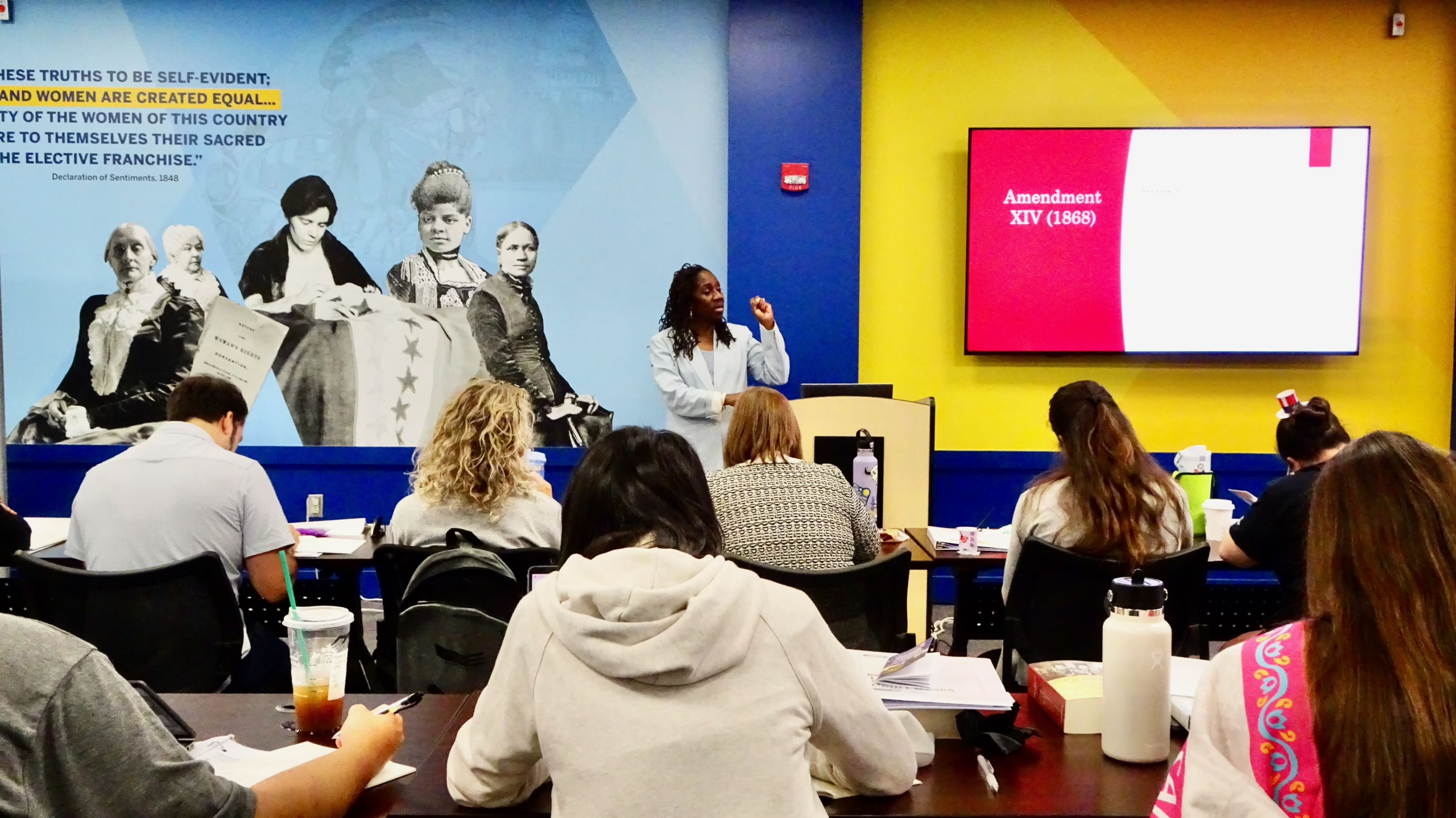
Reviving the Promise of the 14th Amendment
How to make the centerpiece of Reconstruction come alive again.
Sherrilyn Ifill Jan 15, 2026
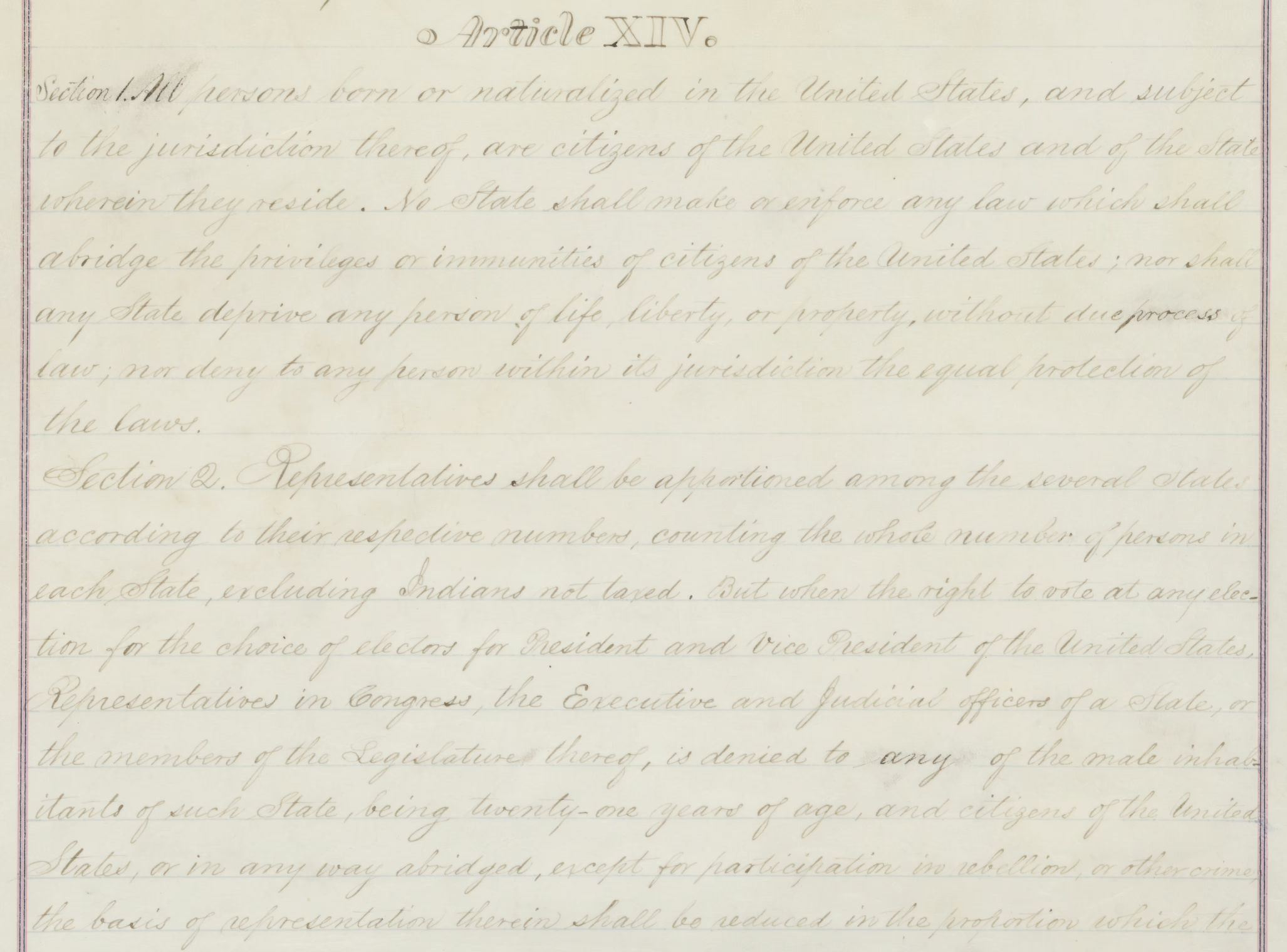
The House Joint Resolution Proposing the 14th Amendment to the Constitution, June 16, 1866. National Archives.
A version of this academic essay was originally published in the Howard Law Journal.
* * *
Eric Foner, the foremost historian of the Reconstruction period, describes the 14th Amendment as “the most important amendment added to the Constitution since the Bill of Rights in 1791.” The 14th Amendment is the longest Amendment in the Constitution, and it is the most cited provision of our Constitution in litigation. Its provisions offer protection for the rights of citizens, racial minorities, women, immigrants, and corporations, among others, and protect all persons against infringement by states on our core democratic rights. It is the 14th Amendment that embodies the vision of America as a multi-racial democracy. Yet, still most Americans know very little about the Amendment and its seminal place in shaping America’s modern national identity.
The absence of academic or advocacy organizations devoted to the study and reach of the 14th Amendment is illustrative of this. The launch of the 14th Amendment Center for Law and Democracy at Howard Law School this year, is designed to create a space and context in which we wrestle with the implications of the derailed promise of the 14th Amendment, and to engage in collaborative strategies with lawyers, business leaders, artists, and journalists to breathe new life into this most potentially transformative constitutional provision.
Why the 14th Amendment?
The 14th Amendment is rightly understood as a “plan for rebuilding a shattered nation” and a blueprint for a new America. It was designed not only to address the exigent circumstances of the moment, but to “forevermore secure the safety of the Republic.” But its promise, its invitation to reset American democracy was thwarted, derailed within thirty years of its ratification. It took the vision, activism, and lawyering of visionary Black activists and attorneys to revive the Amendment’s promise and power in the 20th century.8 But, as in the 19th century, that revival has faced a decades-long backlash. As our democracy teeters on the brink of existential crisis in the 21st century, the 14th Amendment offers a way forward. The guarantees and protections of the Amendment remind us of the bold vision and intention of our Second Founding.
But the context of the Amendment’s creation and ratification, the bold and ambitious nature of the project of re-making our nation after the Civil War also offers us a compelling and instructive guidance as we face profound fracture in our democracy yet again. It is not only war that can divide a nation. And constitutional amendments are not always necessary to set our nation on the path to strengthened democracy. But the lessons of the 14th Amendment—its substantive provisions, and even the history of how its promise was derailed—offer important instruction for contemporary democracy advocates. Moreover, there is still a great deal of life yet in the 14th Amendment, and the project of reinvigorating the Amendment as a framework for our democracy and our national identity remains a worthy and urgent project.
Reviving the Full Force of the 14th Amendment
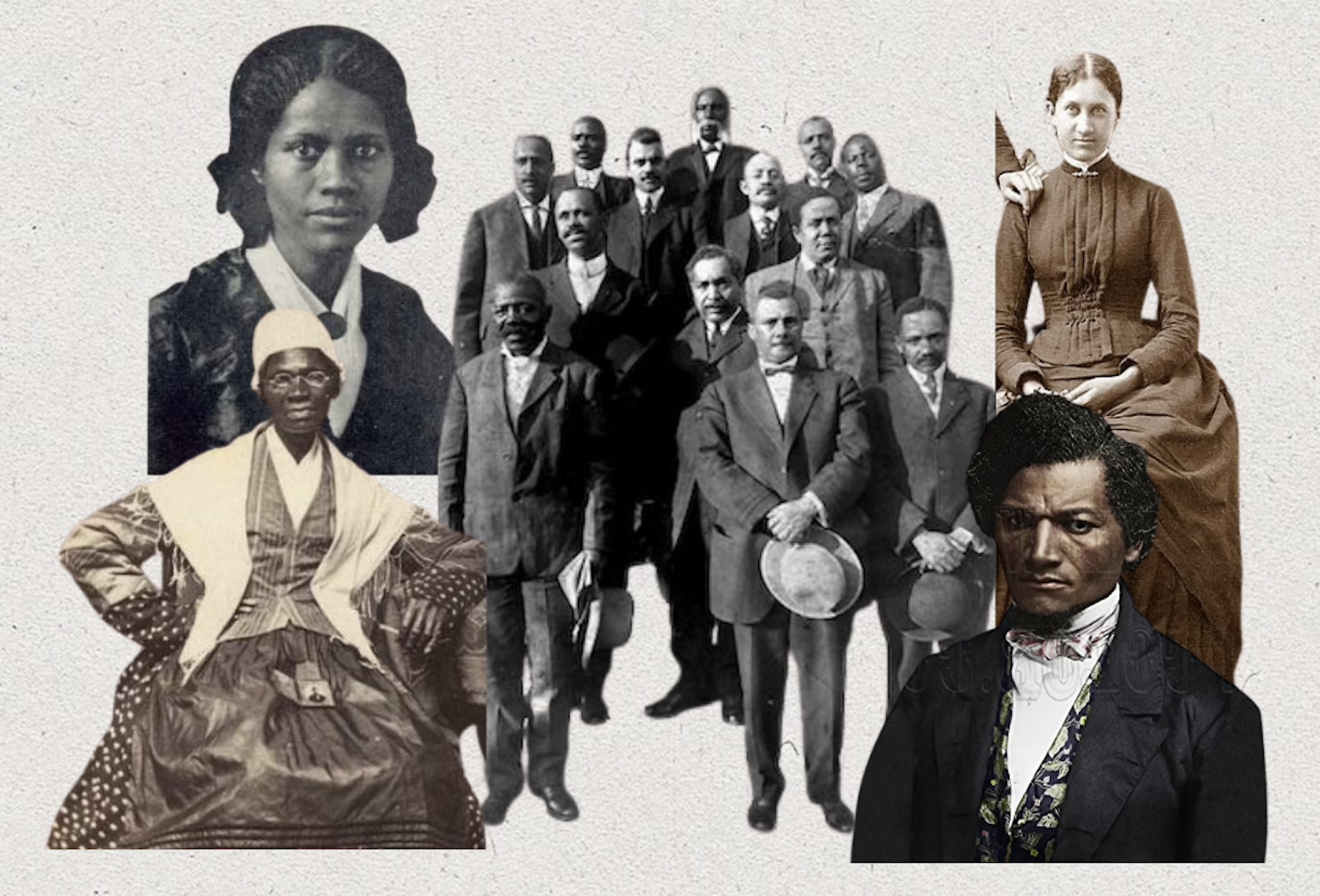
The history of the United States’s “Second Founding”—a term coined by Eric Foner—under the 14th Amendment has been obscured for most Americans. When asked to name the founders and framers of the Constitution, even highly educated Americans will name Madison, Washington, Hamilton, and Jefferson to the exclusion of figures such as Representative Charles Bingham (R-OH), the principal drafter of the 14th Amendment; or Representative Thaddeus Stevens (R-PA) or Senator Charles Sumner (R-MA), “Radical Republican” members of Congress who were instrumental to the drafting and stewardship of the Amendment’s adoption and ratification. And certainly removed from this category of constitutional framers are also key Black and women historical figures such as Frederick Douglass, the formerly enslaved man who escaped and became the most consequential abolitionist and anti-slavery orator, and who intentionally deployed the use of a new, artistic technology—photography—to curate and disseminate images of himself that countered narratives of Black inhumanity. The photographic images of Douglass, his undeniable nobility and dignity, and his status as a formerly enslaved person, were important influences in ongoing discussions about the fitness of Black people for citizenship. Douglass became the most photographed man of the 19th century.
Women played a powerful role in shaping conceptions of equality as well. Black abolitionists like Frances Ellen Watkins Harper, and the influential suffragist Elizabeth Cady Stanton, pushed ongoing debates about the role of women as citizens. Participants in the many Colored Conventions in the decades leading up to the Civil War used the petitioning process to press their demands and ideas to elected officials and leaders. And free Black people who fought to negotiate their place in American society, often as small, independent tradesmen or as sailors also contributed to debates about what the elements of freedom would need to be to ensure the ability of Black people to access the benefits of citizenship. Enslaved people were “founders” as well. The consistent, unrelenting efforts of enslaved people to find freedom, to hold together their families, to learn to read, to find pockets of economic autonomy even within the slave system, all powerfully influenced American conceptions of liberty and of the essential components of citizenship in the decades preceding the Civil War.
This expansive view of “founders and framers” is an intentional lens through which students in my 14th Amendment seminars approach the materials for our class. Recognizing the broader and more diverse influences that come to bear on the eventual formalization of rights and democratic protections is critical to the study of how democracies are built and how law is made.
More alarming than the lost history of the “founders” of our post-Civil War republic, has been the “lost text” of the Amendment—the disappearance of Sections 2 and Section 3 from law school instruction and from the recognition of most constitutional lawyers.
In most law schools, students learn principally about only two sections of the 14th Amendment—Section 1 and Section 5, as part of a standard Constitutional Law course. Section 1 of course includes the guarantees of birthright citizenship, equal protection and due process of laws. While the Bill of Rights protects Americans against infringements on liberty by the federal government. The 14th Amendment constitutes an explicit recognition that protection against the action of states is also necessary. The Amendment was designed specifically to ensure the full citizenship of Black people in the United States—both formerly enslaved and free. The first sentence of the 14th, which guarantees birthright citizenship, is the constitutional provision that overturns the Supreme Court’s decision in Dred Scott v. Sandford. In that case, the Supreme Court, led by Chief Justice Roger Taney deemed Black people—both enslaved and free—ineligible for citizenship. In this way, the Dred Scott decision made Black people stateless persons prior to the Civil War. After the War, the 39th Congress ratified the Thirteenth Amendment outlawing slavery, and passed the Civil Rights Act of 1866, the nation’s first civil rights law. The Civil Rights Act purported to confer citizenship on Black people. But when the bill was vetoed by President Andrew Johnson, Congress (even after overriding the veto) recognized the need to anchor Black citizenship in the Constitution, lest future Congress’ renege on the promise of Black citizenship.
Section 1 also guarantees protection for the privileges and immunities of citizenship and due process rights. Most significantly, Section 1 includes the guarantee of “equal protection of laws,” the constitutional source for what has become the expectation among Americans of equality as a core component of citizenship. It is important to recognize that this conception of citizenship, which seems so rooted in American democracy, is not a product of our pre-Civil War Constitution. Our original Constitution did not include or embrace the concept of equality. Instead, the original Constitution included the provision that required that the enslaved would be counted as three-fifths of a person for congressional representation, and a provision allowing the continuation of the slave trade (delicately referred to as “the importation of persons”) until 1808.
In its explicit guarantee of equality before the law, the 14th Amendment reaches back over the shameful compromises of the first constitution to the clear and intentional language of equality in the Declaration of Independence: “we hold these truths to be self-evident that all men[sic] are created equal.” In this way, the 14th Amendment is a profoundly unifying statement of national identity, finally fully integrating the vision and identity of our nation articulated in America’s statement of nationhood into our Constitution.
Section 5 of the 14th Amendment is familiar to most law students. It assigns the power to enforce the protections set forth in the Amendment to Congress. This is critically important of course. The intentional positioning of the federal government as a bulwark between Black people and the states is powerful—not only because of what it says about the Framers grasp of how deeply white supremacist ideology was steeped in southern states. But it is powerful also because it creates a new identity and set of responsibilities for the federal government. The creation of the civil rights statutes like the Ku Klux Klan Acts in 1870 and 1871, enacted to provide a remedy for Black communities facing white mob violence, and the creation of the Department of Justice in 1870 to prosecute under the new civil rights statutes, further solidified this conception of federal responsibility towards protecting the full citizenship of Black Americans.
Given the significance of Sections 1 and 5 of the 14th Amendment, it is understandable that they would be given primacy, and even exclusivity in law school instruction.
Heeding the Amendment’s Cautions: Insurrection and White Supremacy
But by leaving out attention to Sections 2 and Section 3 of the Amendment, generations of law students and lawyers have been left with little basis for understanding how the framers clear-eyed and pragmatic understanding of challenges that could undermine the guarantees and protections so fulsomely set forth in Section 1.
Understanding Section 2 and 3 of the 14th Amendment requires taking a deep dive into the materials and investigations that informed the work of the 39th and 40th Congresses. This includes the report by Carl Schurz, an emissary appointed by President Andrew Johnson to investigate conditions in the South, and the report of the Joint Committee on Reconstruction. It requires some understanding of the nature of debates among members of Congress about the proposed provisions of the 14th Amendment. For example, it seems odd to us today, but Section 1 of the 14th Amendment garnered relatively little debate and controversy. There were concerns raised by some members over the extension of birthright citizenship to children of Chinese laborers—a matter raised, discussed and settled with the understanding that such children born on U.S. soil would be citizens.
It was Sections 2 and 3 that garnered the most passionate and contentious debates among the members. There were representatives who proposed that those who participated in the insurrection should be barred from voting. Their own experience with former Confederates, a number of whom demanded to be admitted to Congress as representatives of their states even before insurrectionary states had been readmitted to the Union, convinced the congressional committee drafting the 14th Amendment that two stubbornly persistent phenomenon presented an ongoing threat to the potential of a unified multiracial democracy: the deeply-held embrace of insurrection and white supremacist ideology. Frederick Douglass, who demanded that Congress include an affirmative right to vote for Black men in the 14th Amendment contended that this spirit would “pass from sire to son.” He predicted “it will not end in a year; it will not end in an age.”
Rather than include an affirmative right to vote (which many northern white representatives opposed because of their states restrictions on voting based on property ownership and literacy), the drafters compromised on a punishment regime for states that engaged in voter suppression against Black men. Section 2 provides that any state that bars men over age 21 from voting will have its representation in Congress reduced in proportion to the number of voters who are disenfranchised.
To protect against the ongoing spirit of insurrection, the framers drafted Section 3. It forbids those who engaged in insurrection from serving in state or federal office.40 It is a disability which can only be removed by a two-thirds vote of Congress.
In 2024, the state of Colorado refused to include then former President Trump on the ballot because of Section 3 of the 14th Amendment. The decision was upheld by the Colorado Supreme Court. But the United States Supreme Court decided that Colorado did not have Section Three authority to remove Trump from the 2024 president ballot in Colorado without some affirmative authorizing legislation from Congress. The Court’s interpretation was roundly criticized by scholars and commentators across the ideological spectrum.
The Power and Promise Subverted, Restored, and Diminished Again
Despite the power and promise of the 14th Amendment, by the turn of the 20th century it had been largely rendered powerless to ensure the full citizenship of Black people. Hostile Supreme Court decisions, Congressional inaction, and most alarmingly, and ongoing racist violence, returned many Black people to a condition of near-servitude by the dawn of the 20th century, and at the very least ensured that all Black people lived as second class citizens in our republic.
It took decades, and dogged determination by ordinary people—civil rights activists and lawyers who revived the 14th Amendment in the middle of the 20th century. Civil rights lawyers successfully worked to overturn the Supreme Court’s devastating decision in Plessy v. Ferguson, which had endorsed the hardening legal apartheid in half the country. This goal was finally accomplished when the Supreme Court overturned Plessy in Brown v. Board of Education in 1954. The lawyers who conceived of, strategized, and litigated those cases were trained here at Howard Law School. Their mentor, the Dean of the law school, Charles Hamilton Houston, was the most consequential lawyer of the 20th century. His vision of Black lawyers as “social engineers,” and the lawyers he trained— including Thurgood Marshall, Pauli Murray, and Oliver Hill among others—resuscitated the 14th Amendment from the dustbin of American constitutional history.
Brown opened up the democratic imagination of Black people across the country. To have the Supreme Court affirm the firstclass citizenship of Black people was powerful and encouraged Black people to believe that the broken promises of Reconstruction might yet be fulfilled. Through the use of boycotts, sit-ins, marches and protests, civil rights activists compelled Congress to act at long last to enact legislation to enforce the rights guaranteed under the 14th Amendment. The passage of the Civil Rights Act of 1957, the Civil Rights Act of 1964, the Voting Rights Act of 1965, and the Fair Housing Act of 1968, constituted the high point of Congress’s use of its Section 5 enforcement power. Then, for a brief period of twenty years, from 1954 when Brown v. Board of Education was decided until 1974 when the Supreme Court began its civil rights retreat, the power of the 14th Amendment was revived. A slow but steady retrenchment began in the late 1970s and took firm hold by the 1980s. But even during that period, Congress remained, by and large, supportive of civil rights, demonstrating bipartisan commitment to the Voting Rights Act, and standing in favor of protections against employment discrimination, and programs supporting Black economic advancement.
Today we are facing the greatest hostility to the 14th Amendment since the post-Reconstruction period. Indeed, we are now in a period of full-blown hostility to the project of multiracial democracy. An anti-civil rights platform has become the platform of one of our two major political parties, and white supremacist ideology has become acceptable political rhetoric and policy. At the same time, the Supreme Court has aggressively narrowed its interpretation of the guarantees of the 14th amendment (except in the context of corporations which, since the 1880s when the Supreme Court began issuing decisions that embraced the concept of corporate “personhood” under the 14th Amendment, have enjoyed ever-expanding 14th Amendment protections).
The concept of “colorblindness”—taken from the dissent of Justice Harlan in Plessy v. Ferguson—has become a kind of incantation, a shibboleth, which the Court invokes to either weaken or strikes down efforts designed to overcome the significant and ongoing effects of systemic racism that the Court itself enabled through its decisions in the late 19th and first half of the 20th century. From programs designed to promote long-denied opportunities for minority to voluntary desegregation efforts, to voluntary race conscious college admissions programs, the Supreme Court has once again become the architect of a diminished and enfeebled 14th Amendment.
How Should We Approach the 14th Amendment Today?
Given this rather dire history, some might argue that the lesson of the 14th Amendment is that pursuing a multiracial democracy anchored in equality is a fool’s errand. I see it quite differently. No one would suggest that the First Amendment is a dead letter simply because free speech rights are being restricted in a variety of ways. Or that we should not pursue claims of right counsel or an impartial tribunal under the Sixth Amendment simply because injustice in the criminal legal system remains a reality. Why then should Black people relinquish the 14th Amendment as a source of the promise of first class and equal citizenship?
I argue that we must return to the 14th Amendment and work to invigorate an understanding of it—not only by lawyers and judges—by among ordinary Americans. Taken as a whole, the Amendment demonstrates that we can do two things at once. We can speak to America’s soaring promises of equality and justice, and also recognize with a pragmatic eye that there are forces, deeply embedded in our national character, that must be guarded against if we are ever able to achieve the goal of a healthy, robust democracy for which we all hope.
It is not a small thing, to bury an aspect of history so central to the integrity and arc of American democracy. This should compel us to ask not only how the story of the 14th Amendment has become such a footnote to our memory, but why.
And this compels me to make one other point. The story of the 14th Amendment, its founders, and of the nascent efforts to enforce it, was deliberately buried. In its place, southerners advanced the “Lost Cause” narrative—a story of southern chivalry and gentility, over northern takeover, and of rapacious and unqualified Black people who were unfit for citizenship. That story was advanced through a textbook project, initiated by the United Daughters of the Confederacy, designed to teach public school children a sanitized version of the antebellum south, of slavery, and of Reconstruction—an account that ennobled slaveholders and the Confederacy. It was this movement in the early 1900s that also spearheaded a project to build confederate monuments, which until recently were fixtures in cities and towns throughout the country. It took more than 100 years for activists to begin a concerted challenge to the dominance of these monuments in public places. First in Charlottesville in 2017, and then more widely in 2020 after the murder of George Floyd in Minnesota, Black activists fought to remove these exalted venerations of white supremacy from public squares, courthouses, university campuses and other public spaces. More importantly, they opened up a critical interrogation of how decisions are made about the history we celebrate through public monuments. This has become a rigorous area of study and scholarship.
But there was a scholarly element to the narratives that buried the truth about the 14th Amendment and Reconstruction as well. Historian Charles Dunning and his students and mentees at Columbia University, published scholarship that became known as the “Dunning school” of Reconstruction history. Their work was powerfully influential for decades and shaped how most adults in the second half of the 20th and early 21st century came to understand Reconstruction. More rigorous accounts that gave voice, agency, and analysis to the actions taken by and against Black people, like W.E.B. DuBois’s Black Reconstruction, 61 were read by Black scholars, but did not reach mainstream post-Civil War studies until after the creation of Black studies programs on college campuses in the late 1960s.
This experience reminds us that narrative is important. We ignore it at our peril. “Winning” requires more than court victories and the passage of new laws. We must attend to the story that is told about lawmaking. We must speak not only to courts—and in the current climate of the Supreme Court—perhaps not even principally to the courts. We must educate legislators, educators, business leaders, and ordinary people about the 14th Amendment’s promise and history.
I contend that the story of the 14th Amendment, of Reconstruction, and of those who dared to believe that we could make one unified democracy out of our fractured one is a noble story of which Americans should be proud. It is an account from which we should draw power, to fuel the democratic imagination we need to confront our contemporary challenges.
There are hit plays that celebrate Alexander Hamilton, and television series that elevate John Adams, and no shortage of literary encomiums to George Washington and Thomas Jefferson. That there has never been a motion picture about the life of Frederick Douglass, or of Charles Sumner is telling. The arc of Douglass’s life, from his enslavement on the Eastern Shore of Maryland and in the port of Baltimore, his daring escape by train to New York, and his transformation into a renowned orator, writer and public intellectual would seem to present rich cinematic possibilities.
Charles Sumner was beaten nearly to death on the floor of the United States Senate by South Carolina Representative Preston Brooks. The attack was vicious, premeditated and undertaken in retaliation for Sumner’s anti-slavery remarks three days earlier, which Brooks believed was targeted in part at a distant relative. The savagery of the attack—when the cane he used to beat Sumner broke during the attack, Brooks continued the beating with the remaining end of the cane—was shocking. Sumner was gravely injured, and was unable to return to the Senate for three years. His empty desk on the Senate floor during that time served as a reminder of the brutality that southerners were prepared to unleash in order maintain slavery. Sumner’s vindication came in the 39th Congress with his role as one of the principal leaders and architects of the Reconstruction Congress. Again, the cinematic possibilities of this violent precursor to the Civil War, are rich.
But these powerful stories have not been given the kind of treatment afforded to the lives of the founders and framers of our original Constitution, and thus these figures and their contribution to our nation have not become members of the cast of characters routinely understood to be the “founding fathers” of our nation. For this reason, engagement with art and artists is a critical part of the 14th Amendment seminar I teach, and it is intentionally part of the collaborative network of the 14th Amendment Center.
*
I am mindful of the great work undertaken by graduates of this law school to breathe new life into the 14th Amendment. Under their care and shaped by their strategic vision, the 14th Amendment took center stage in bringing a measure of true democracy to this country for the first time. Many of us are beneficiaries of that extraordinary work. The principal beneficiary is American democracy which could not rightly be said to exist while half the country was governed by a system of legal apartheid.
Those lawyers and advocates who ultimately “broke the back of Jim Crow” gave our nation the gift of democracy. That they accomplished this at a time when they themselves were not regarded as full first-class citizens of this country tells us that our ability to imagine and work towards fulfilling a vision of democracy is stronger than the reality of oppression. It is my hope that the 14th Amendment Center for Law & Democracy will be a place where we can not only imagine but undertake substantive work that fulfills the promise of this most consequential addition to our Constitution.
* * *